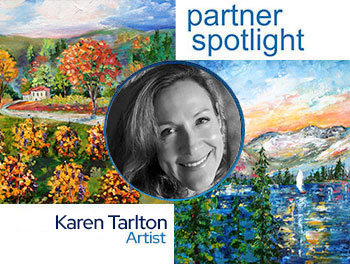
Today’s Partner Spotlight features Lindy Gaskill talking about the artistic creative process, influences, and her one-of-a-kind approach to whimsical art. Lindy is an acrylic painter living in the Pacific Northwest, inspired by the landscape, nature, and joy of daily life in this region.
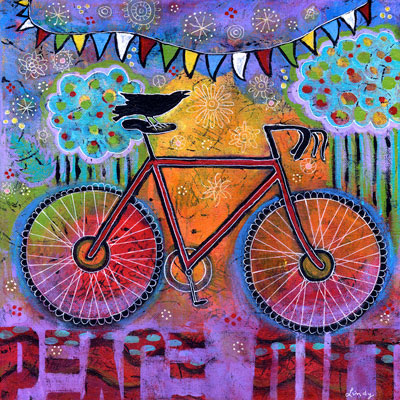
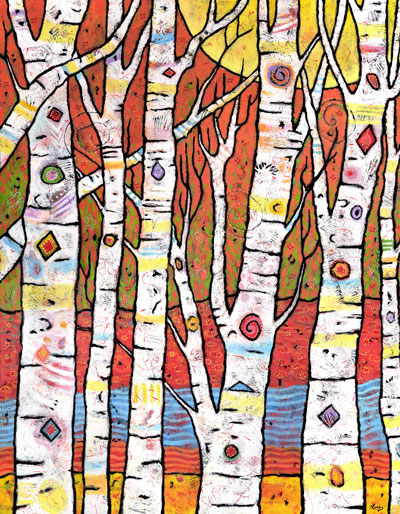
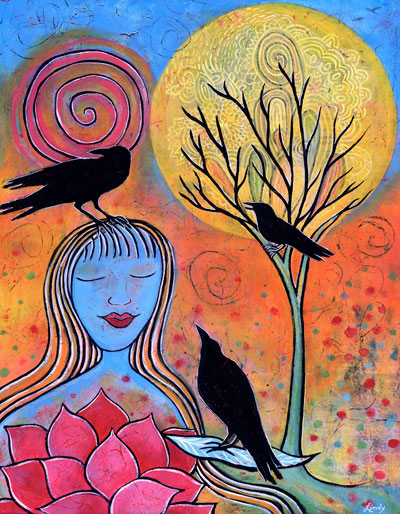
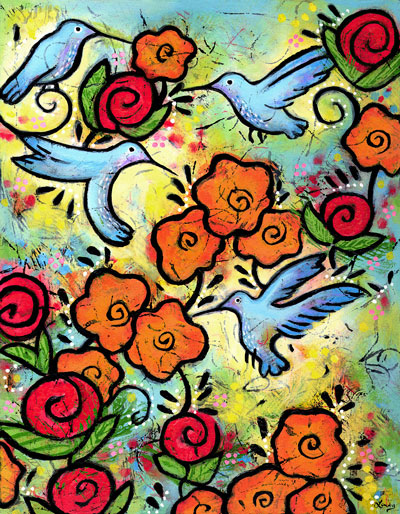
Her work is immediately recognizable by bright color, playful imagery, stacked surfaces, and positive energy. Her whimsical paintings often contain sunshine yellow, sky blue, Mediterranean green, spirals, birds, trees, bicycles, and people expressing themselves.
Lindy’s work also demonstrates how acrylic painting techniques can be part of an artist’s visual identity. She builds texture, reveals hidden colors, and experiments with surprising ways of making marks to give her work depth and character. Besides choosing the right print medium, artists should also consider how to translate original artwork into reproductions so that the texture, color, and personality of the original work are conveyed in the finished print.
To help bring her colorful artwork to customers, Lindy has partnered with Lumaprints as her trusted print provider.

1. What medium do you use for your art style? Is there a specific reason you chose this medium?
I love using acrylics as my medium of choice because I like the look of layered patinas and vivid color. I can create that look using acrylics. Acrylic paint dries fast, so layering acrylic paint is really easy. Sometimes I take a painting and run it under water and scrub some of the paint off to reveal the layers underneath. This creates an aged look that I like.
2. Can you describe your art and your art style?
All my colorful art is made with the intention of spreading happiness and positive energy! Whimsical and colorful is my art style. The imagery I use is often fun and playful. My paintings have ravens and hummingbirds, animals, bicycles, colorful trees, flowers, and, in recent years, people.
I have been making things since I was very young. When I was a child, I would make something, like a drawing, or glue styrofoam together to make a castle or some other creative project, and then present it with a “see what I made” show and tell.
Growing up in our family, art was talked about, art galleries were visited, and lots of art was on the walls. My parents, being very creative themselves, enjoyed art so much! Making art, showing art, and buying art were encouraged and celebrated. I still feel this drive to create and share it today.
“People do.” I like this saying because when you do something out of the ordinary, you can say, “People do.”
5. Can you discuss a specific piece of art that you are particularly proud of and why?
One of my favorite pieces was from when I lived in Bend, Oregon. It was a fun painting of a whimsical winter scene I did when Deschutes Brewery asked me to be their 2007 Jubelale artist.
It was an honor to have my art featured on their festive winter beer called Jubelale. Each year, Deschutes Brewery showcases a new piece of art crafted by a regional artist. It meant that my art would not only go on their beer label but on other items as well.
It was a super fun event at the brewery! In 2022, they opened up the application process to all U.S. artists 21 and older, so go check it out on their website.
6. Can you walk us through your creative process from start to finish?
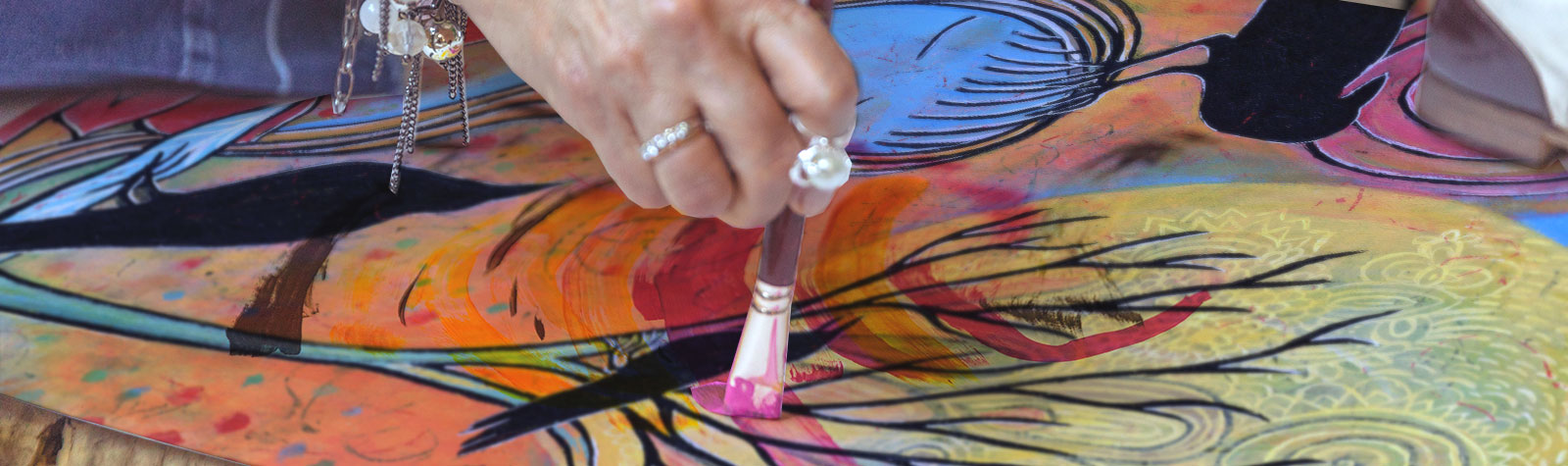
I developed my technique when I lived in New York City in the late ’90s. Creating layers is important to my process. I first cover heavy watercolor paper or a wood panel with a few coats of white gesso, and then I start layering paint and making marks.
Halfway through the painting, the imagery comes in, and I use a black line to outline forms. I like to use a special print technique of scratching into paint on waxed paper and pressing it onto the painting to create texture.
I also use string dipped in paint to create squiggly lines for interest. Since I love the spiral symbol, I create spirals in the background with the string and cover up marks with washes. I make some images look like they are glowing with energy, as I believe we are all connected by our energy.
Sometimes I put the painting under running water to get to the underlying layers, or I sand it with sandpaper. Most importantly for me, I have fun with the process!
Lindy’s approach is a great example of how acrylic painting techniques can become part of an artist’s signature style rather than simply a set of technical steps. Artists interested in building similar visual depth can explore acrylic glazing techniques to better understand how transparent layers can create richer color and dimension.
7. How do you handle creative blocks or challenges in your work?
I usually take a break and go outside to be in nature. Or I make sketches in my sketchbook, and that can inspire me to get back to painting. I have been painting long enough now to know that taking a break from painting can be a good thing and help me come back to it with fresh eyes.
8. What is your advice to aspiring artists?
Keep on painting and develop a style that is all your own! Also, learn the business and marketing side of selling art, if that is what you want to do. I think that is something that is not emphasized enough in art school.
9. Your Etsy store, “Artwork by Lindy,” is a top shop for gifts. How do you handle customer inquiries and concerns, and what steps do you take to ensure customer satisfaction?
Lumaprints does such a beautiful job of printing my art! Customer satisfaction is of top importance, so I get back to an inquiry as soon as possible. I also offer a refund policy on most of what I sell in my Etsy shop, but it is very rare to have that happen, as my customers have been thrilled with my prints, which I offer on fine art paper or canvas.
10. What is your pricing strategy for your Etsy listings, and how do you determine the appropriate prices?
I take into consideration the different fees that are charged by Etsy, as well as the print and shipping costs and my time. I compare what others on Etsy are selling their work for, so I am competitive, but I also want to price my work so that if I decide to wholesale my prints, I will still make a profit.
Artists building their own product line can also review Lumaprints’ guide on how to price art prints for additional guidance on production costs, shipping, fees, and margins.
A few of my most popular pieces are the bicycle and raven prints and my whimsical trees. I think they represent a playful side of life that people are attracted to. I like to surround myself with vivid color and art that makes me feel good and reminds me to enjoy life, and I think these pieces do that.
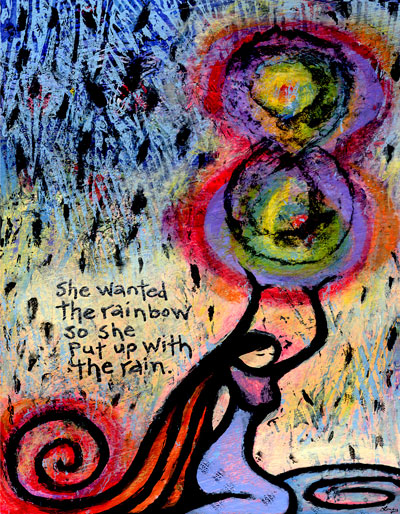
Another piece that is very popular is my “She Wanted the Rainbow, So She Put up with the Rain” print. This was a piece that I did for a fundraiser. I was given a quote with the stipulation that you had to create a painting using the quote and complete it in two hours or less.
There is a lot of symbolism in this piece, and I think women relate to it and the title. I don’t usually interpret my work for people, as I like them to relate to it in their own way, but I do believe the title of a piece can inspire its popularity.
Frequently Asked Questions
What is whimsical art?
Whimsical art often uses playful subjects, imaginative details, expressive shapes, and unexpected combinations of color or imagery. Lindy’s birds, colorful trees, bicycles, animals, and figures are examples of how whimsical art can communicate joy and personality.
What acrylic painting techniques does Lindy Gaskill use?
Her process includes layering acrylic paint, washes, sanding, removing portions of paint to expose earlier layers, string painting, black outlines, and transferring scratched textures from waxed paper.
Why is layering acrylic paint useful?
Layering allows artists to gradually build color, texture, contrast, and visual depth. Because acrylics dry relatively quickly, artists can develop multiple layers without waiting as long as they might with slower-drying media.
What inspires Lindy Gaskill’s whimsical paintings?
Nature, childhood creativity, family exposure to art, playful imagery, vivid color, and her desire to spread happiness all influence her artistic creative process.
Can acrylic paintings be reproduced as art prints?
Yes. Acrylic artwork can be reproduced on formats such as fine art paper and canvas. The best option depends on details such as texture, color, image resolution, desired presentation, and how closely the artist wants the print to reflect the character of the original.
Learn More About Lindy and Her Art
Website: Art By Lindy
Facebook: artbylindy
Instagram: @artbylindy
Etsy: Artwork By Lindy
If you would like a free colorful tree print—just pay a small shipping fee—plus some other freebies, visit the Lindy Gaskill – Art by Lindy Website.
Inspired by Lindy’s journey from original acrylic paintings to finished prints? Give your own artwork the same attention when choosing how it will be reproduced. Explore Lumaprints’ canvas printing guide to learn how image preparation, canvas texture, sizing, and print quality can help turn original artwork into wall-ready prints.